

Purchase Mother as Conjunction through IngramSpark
Purchase through Amazon
Synopsis
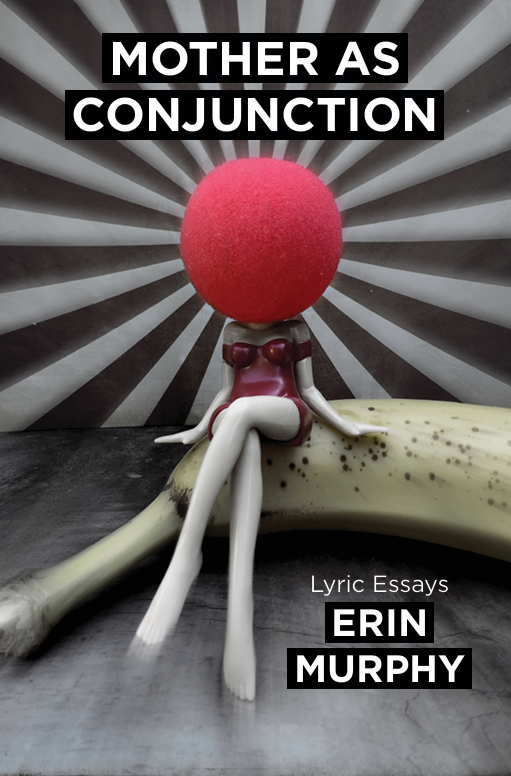
In Mother as Conjunction, you’ll encounter TV game shows, Elvis, and pyramid schemes. You’ll also come face to face with bullying, trauma, and violence. Marked by tenderness, humor, and images that gleam with precision, these lyric essays are especially concerned with the nuanced narratives of mothers and daughters—the “stories that become our songs.”
Praise for Mother as Conjunction
Erin Murphy’s compelling collection of lyric essays, Mother as Conjunction, is at times playful, at times reflective, always spirited and surprising. Murphy notices the world around her—she did so even as a child, we learn—and these hybrid essays recreate that world in glowing, evocative detail.
—Dinty W. Moore, author of Between Panic and Desire
Approaching the quirks of the 20th century with something shrewder than nostalgia and giving us a 21st century we might understand more deeply, Mother as Conjunction provides a glimpse into caretaking in all its myriad forms. The compassion Murphy feels for others and for her current and former self is transformative. This is a stealthy collection that builds beautifully into a generous, unforgettable reading experience.
—Lynn Melnick, author of I've Had to Think Up a Way to Survive: On Trauma, Persistence, and Dolly Parton
“Is daughter ever a verb?” asks the narrator of “Into the Answer,” a question that feels like it’s in cahoots with the enigmatic title of Erin Murphy’s lyric essay collection, Mother as Conjunction. Mother as verb we get. To mother is to tend, to protect and even, sometimes, to sever. But how can daughter be a verb? How can mother be a conjunction? It’s precisely this fascination and facility with language that animates these tight, elegant pieces about love and family and “the architecture of the ordinary.” Clearly penned by a poet fully in tune with dead-ended etymology (“strum” does not come from “instrument”), malapropisms (“pretty” becomes “pity,” as a toddler stares at threatening flames), and the irony of human error as a sign misspelled to read “no swiming” means an afternoon of swimming at the lake despite a park ranger’s exasperated warning. There is sonic pleasure at the sentence level as homemade rolls are “yeasty heaps of buttery heaven, kneaded,” as well as in moments of figurative language (‘my mother crumbled like a used tissue”), and formal inventiveness (essay as list of interview questions, as dictionary entry)—all of which work in service of the very human stories on offer. “I barely know what a parabola is, but I want to climb inside the word,” says the narrator of “Shaped” and this reader wants to follow, sure that all mysteries, lexical and emotional, will be answered for me therein.
—Sheila Squillante, author of All Things Edible, Random and Odd: Essays on Grief, Love and Food

Erin Murphy’s work has appeared in The Best of Brevity, Best Microfiction 2024, and anthologies from Random House, Bloomsbury, and Bedford/St. Martin's. Her most recent books are Human Resources, Fluent in Blue, and Taxonomies. Her edited anthologies include Creating Nonfiction and Bodies of Truth: Personal Narratives on Illness, Disability, and Medicine, both of which won Foreword INDIES Book of the Year Awards. She is professor of English at Penn State Altoona.
Website: www.erin-murphy.com